I use many different woods in my items. Below are representative pictures of the woods I often use. Being a natural product, each piece of wood is unique, so what it looks like is different in a finished piece. There is also a description of the wood next to each picture.
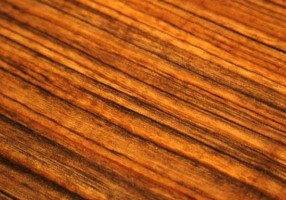
Amazique is also known as Ovangkol or Shedua. This beautiful African hardwood has been used by several high end instrument companies Worldwide for many years now. It is noted for its good tonality, color, and reasonable price. From Equatorial West Africa, Amazique is still available in large logs. Color is similar to East Indian Rosewood and the grain is interlocked like Bubinga. In fact, Amazique is from the same family as Bubinga and shares many of the same traits.
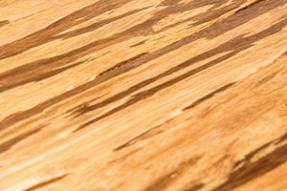
Bamboo is a rapid growing grass that reaches maturity very quickly, meaning that it can be harvested every five years. To make natural strand woven bamboo flooring the bamboo is cut, stripped down, shredded into fiber strands and woven together. It is then compressed under extreme heat and pressure along with a resin. This forms a solid block of strand woven bamboo.
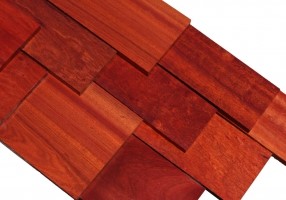
Brosimum paraense. Commercial names include: cardinal wood, blood wood, satine, muiratiranga, satina, and satine rubanne. A dense fine grained wood that takes a high polish and can be used for anything from musical instrument, fine furniture, flooring, dye wood, intarsia, inlay, and more. Dark red stock is getting harder to find and most of the recently imported wood has streaks or light color present. From South America, chiefly Brazil.
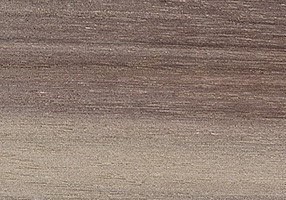
Blue Mahoe, or Mahoe, is native to Cuba and Jamaica; widely planted throughout the Caribbean. Trees reach a height of 60-70 ft tall with a 1-2 ft trunk diameter. Heartwood can be highly varied in color, usually grayish or olive brown colored, sometimes with streaks of green, blue, or purple, and perhaps the only commercially available wood that can exhibit a bluish hue. Grain is usually straight or shallowly interlocked, with a uniform fine to medium texture and a low natural luster.
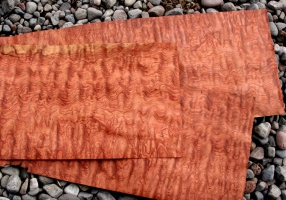
African Rosewood, or Bubinga, is a beautiful hardwood from Africa’s West Coast. Though not a true Rosewood, it is denser than several Rosewoods. A much overlooked tone wood, Bubinga is an up and coming wood that has beautiful color and the possibility of prized figure. Colors range from reds, brown and violet tones. Interlocked grain is very similar to Amazique (which is in the same family as Bubinga).

Prunus serotina is commonly called Black Cherry, Wild Black Cherry, Rum Cherry, or Mountain Black Cherry. The wood produced is hard, reddish-brown and is valued as a hardwood for wood turning, cabinetry, musical instruments and more. Trees grow to heights of 50-100 tall with diameters of 1-1/2 5 feet. The bark is smooth purplish-brown with prominent horizontal grey-brown lenticels on young trees, becoming thick dark blackish-brown and fissured on old trees.
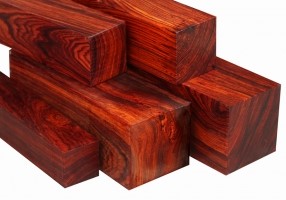
Cocobolo grows on a thin band along the Pacific Coast of Mexico down through Central America. Cocobolo is a true Rosewood, similar in color & tap tone to Brazilian Rosewood and considered to be a good substitute. It is denser than most Rosewoods and oilier. Cocobolo has great working properties & turns to a naturally glass-like polish. The colors range from any combination of orange, red, yellow, & black to violet. For this reason, it has also been called rainbow wood.
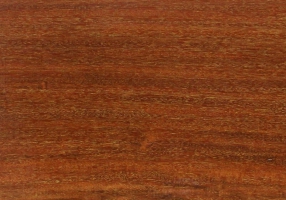
Tabebuia avellanedae. Also called Pau D’arco, Brazilian ironwood, iron bark, and IPE. A plentiful wood with long log lengths of up to a 100′ available. Lustrous brown in color aging to a greenish tinge. The appearance is that of green heart from Suriname but the grain is finer and denser. Averaging 70 pounds per square foot this is an ideal wood for truck decking, flooring, and pilings. Veneer is sometimes available with fine mottle figure. The wood turns to a high polish.

Hawaiian Koa has been treasured for hundreds of years by the Hawaiians. They have used it for anything from outrigger canoes, paddles, boxes, furniture and Ukuleles. It is an excellent tone wood which produces a rich, warm sound. Supply of Koa is getting scarce as the Hawaiians have only recently started replanting the trees. Koa is renowned for its iridescent shimmer and luscious color which ranges from tan to warm gold with brown and black accents.
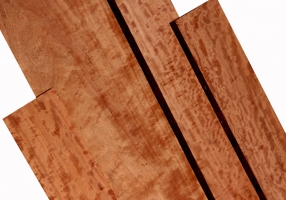
This African hardwood is also commonly known as African Cherry, yielding a finished product with rich pink & golden colors. It has a high silica content in it so it is not the best for machinability but it is worth the effort due to its beauty. One of the contributing factors to its often present mottled figure and chatoyant shimmer is its interlocked grain.
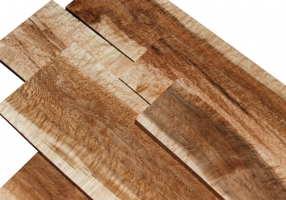
It is known as Hard Rock Maple, Sweet Maple, White Maple, and Black Maple. The highest grade lumber is flat or slab sawn to show the birdseyes (not quartersawn as in curly Maple). This valuable tree produces Hard Rock Maple lumber and Maple Sugar. It is the state tree of 4 states. Birdseye is only present in select logs and produces beautiful wood! The wood works well and takes a nice polish.
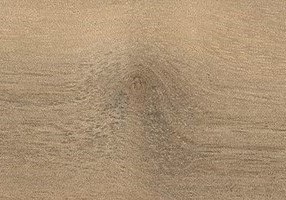
Myrtle is also called Oregon Myrtle, California Bay Laurel or Pepperwood. It grows in the coastal regions of southwest Oregon and central California. Logs can be 50-80 ft tall with a 2-3 ft trunk diameter. Heartwood color can be variable, from light orangish brown to gray or olive, sometimes with darker streaks present. Pale sapwood is usually well defined. Figured grain patterns (curly, mottled, burl) are not uncommon.
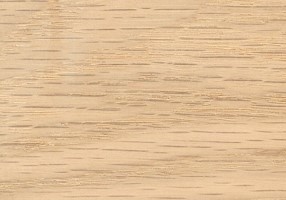
Red Oak grows in Northeastern United States and Southeastern Canada. Trees commonly reach heights of 80-115 ft tall with a 3-6 ft trunk diameter. Heartwood is a light to medium brown, commonly with a reddish cast. Nearly white to light brown sapwood is not always sharply demarcated from the heartwood. Quartersawn sections display prominent ray fleck patterns. Conversely, White Oak tends to be slightly more olive-colored, but is by no means a reliable method of determining the type of oak.
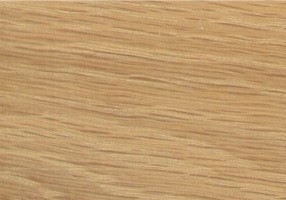
White Oak also known as Quercus alba, is one of the largest trees in eastern and central North America. It typically reaches heights of 80 to 100 feet at maturity, and its canopy can become quite massive. The wood is typically light brown in color with paler sapwood. This open grained, strong wood is one of the best for furniture and hardwood flooring. Uses also include Acoustic guitar back and sides, picture frames, fancy boxes, and other fine articles.
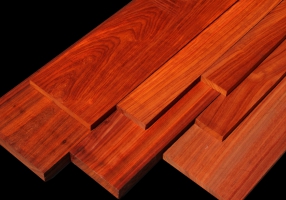
Padauk is a unique open grained hardwood from Africa that has a bright Vermillion color when first cut. Over time it slowly ages to a purple Rosewood color. Huge logs are sometimes available, producing beautiful, large boards. Padauk is a good substitute for Indian rosewood for guitar backs and sides.
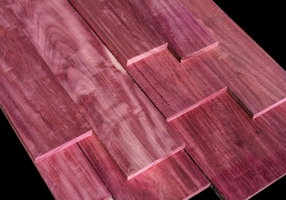
A brilliantly colored hardwood from South America, Purpleheart is very popular for its deep purple color. Ideal for inlay, marquetry, and other fine articles. Occasionally the trees produce either fiddleback or a ropey mottled curl from interlocked grain. The color is a pale brown when freshly cut, darkening to deep violet purple with UV exposure in a few days. The wood has coarse open grain and is dense and durable, so much that it can be used for wharf pilings and truck floors.
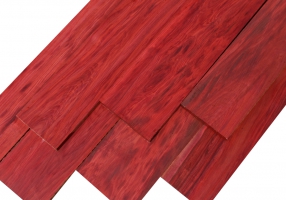
Fine, closed grain makes this Central American hardwood machine easily & finish well. The unique brilliant red color with black undertones is unusual and unmatched in other exotic hardwoods. The Mayans refer to this hardwood is Chakte Koke. Another nice aspect of this hardwood is that it is excellent for turnery due to its great machinability.
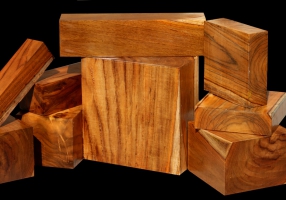
Originating in South East Asia, Teak (Tectonis grandis) has been described as God’s gift to boat builders. It is impervious to water and can tolerate brutal conditions that no other wood can survive. The wood is dense and oily to the touch and is described by some as having a slightly musty smell. Excellent for boat repairs for anything from steps to tables and fittings. Trees are girdled several years before the tree is felled to allow the sap to flow out enough to lighten the log for river floating.

Verawood, also known as Argentine Lignum Vitae, grows in Central America and northern South America. Trees commonly reach heights of 40-50 ft tall with a 1-2 ft trunk diameter. Heartwood color can range from a pale yellowish olive, to a deeper forest green or dark brown to almost black. The color tends to darken with age, especially upon exposure to light. Grain is straight to spiraled or slightly interlocked. Fine even texture with very high natural luster.

Black Walnut (American) grows in the eastern United States. Trees reach a height of 100-120 ft tall with a 2-3 ft trunk diameter. Heartwood can range from a lighter pale brown to a dark chocolate brown with darker brown streaks. Color can sometimes have a grey, purple, or reddish cast. Sapwood is pale yellow-gray to nearly white. Figured grain patterns such as curl, crotch, and burl are also seen. Grain is usually straight, but can be irregular. Has a medium texture and moderate natural luster.
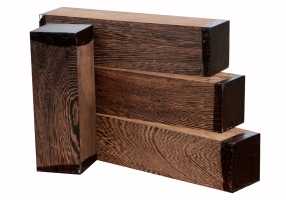
Wenge is a dense wood from equatorial West Africa that has good working properties. Wenge is a good wood in place of ebony and has fine dark lines with narrow brown streaks. Colors range from dark brown or black with light brown streaks.
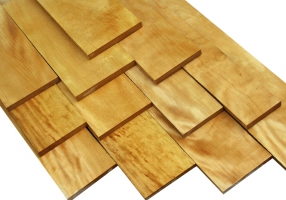
Yellowheart grows on Brazil’s Eastern coastline from the equator South to Rio. The color in the heartwood is a pronounced vivid yellow with creamy white sapwood. There is striping if one looks closely at the grain between the rings. It is also called Brazilian Satinwood for the iridescent ribbon figure that is in quartersawn stock. It works and glues well taking a high polish as the wood is dense and durable.
 Dietz Designs